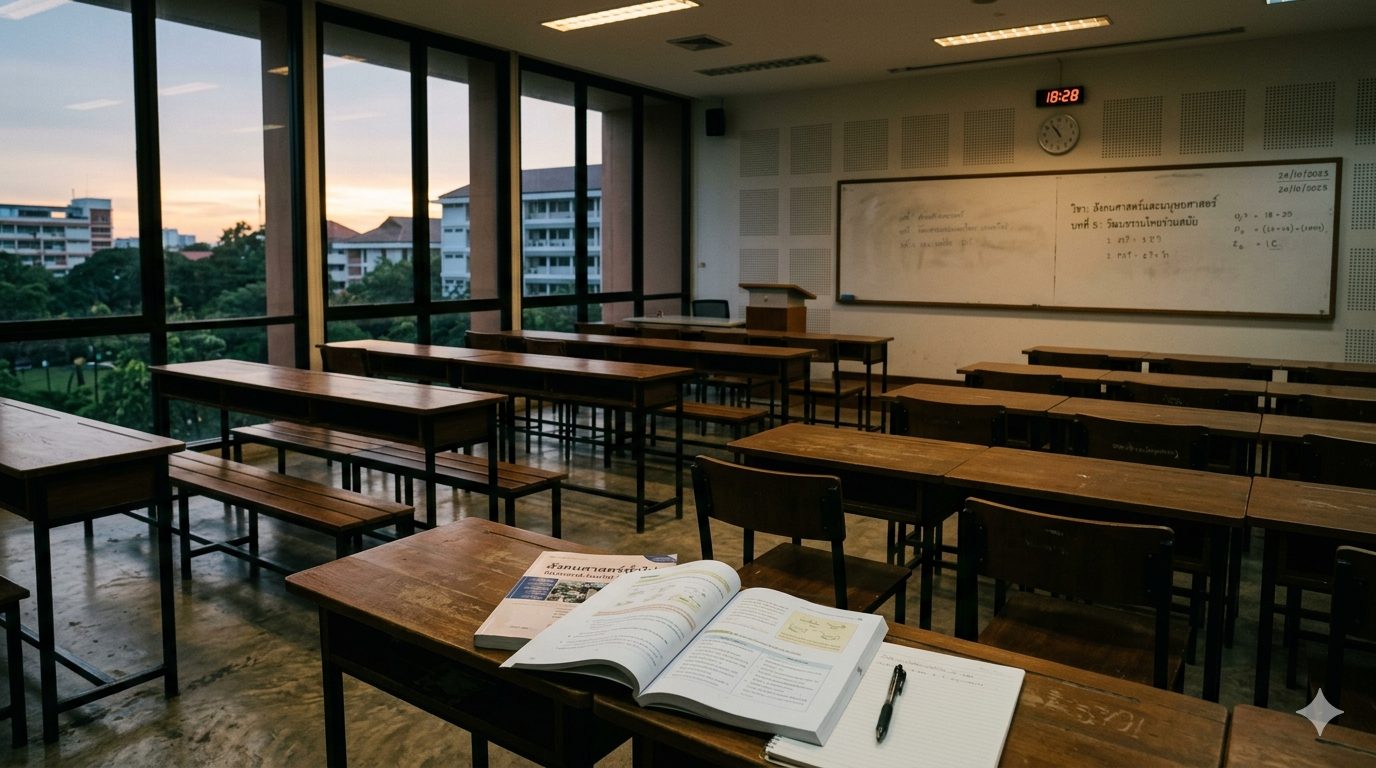
The Thai Immigration Bureau has revoked roughly 10,000 student visas in the latest enforcement push against Non-Immigrant ED visa abuse, and a new Centralized Database System — built jointly with the Ministry of Higher Education, Science, Research and Innovation (MHESI) — now requires every Thai institution to file monthly academic reports verifying actual student attendance. For foreigners using the ED visa as a back-door long-stay tool rather than for genuine education, the risk has materially escalated. For genuine students and for those who never needed an ED visa in the first place, the path forward is straightforward — and this article breaks down both.
What Triggered the Crackdown
For years, Thailand's Non-Immigrant ED (Education) visa has functioned as one of the country's most accessible long-stay vehicles. Enrollment in a Thai language school or short-term cultural program — Muay Thai, Thai cooking, traditional massage — was sufficient to obtain an initial 90-day visa, with extensions of up to a year possible while the program ran. Genuine students used it as designed. A meaningful population of foreigners did not.
According to Thai Immigration Bureau statements, the abuse fell into recognizable patterns:
- Ghost enrollment — foreigners paying tuition fees to a school but never attending classes, treating the visa as a long-stay subscription rather than an education credential
- Fraudulent institutions — schools that knowingly issued enrollment certificates to foreigners with no intent to teach them, in exchange for tuition revenue
- Volunteer-program loopholes — short-term volunteer or cultural-exchange placements used to manufacture eligibility for non-immigrant visa categories
- Bribery within the issuance chain — a separate but related concern flagged by Thai Immigration, where individual immigration officials reportedly approved non-immigrant visas linked to non-genuine activities in exchange for payment
The combined effect has been a long-running gap between the visa's design intent and its actual usage — and, in some reported cases, a connection to other forms of visa-status fraud and unrelated criminal activity. The 10,000 revocation figure represents the first major enforcement wave; Thai authorities have signalled that the campaign will continue.
The New Measure: A Centralized Database System
The structural fix Thailand has chosen is data, not raids. Working jointly, the Thai Immigration Bureau and the Ministry of Higher Education, Science, Research and Innovation (MHESI) have built a Centralized Database System that ingests monthly academic reports from every higher education institution in Thailand offering short-term or non-degree programs to international students.
The reports include:
- Names and passport numbers of all currently enrolled foreign students
- Course attendance records for the prior month
- Program completion or withdrawal status
- Any institution-issued progress assessments
Immigration officers can cross-reference any ED visa holder's name against the database. If the holder does not appear in the school's monthly report, or if the school itself fails to file, the situation triggers review. Two outcomes follow most often: the institution loses its ability to sponsor future foreign students, and the individual visa holder is flagged for cancellation, deportation, and — in cases where fraud is established — permanent blacklisting from re-entry to Thailand.
What This Means If You Are a Genuine Student
If you are actually attending an MHESI-approved institution, the database works in your favor — your name appears in the monthly report and your visa is verified, not threatened. Keep records of attendance, payment receipts, and any progress reports the institution issues. Those documents are the artifacts immigration officers request during enforcement reviews. Genuine students have not been the target of revocations and are not at heightened risk under the current campaign.
The Consequences for Non-Compliant Holders
For foreigners whose ED visa was issued without genuine enrollment intent, the enforcement pathway is now structured rather than discretionary:
1. Visa cancellation notice
The first signal is typically a cancellation notice from Thai Immigration, citing the failure to appear in the institution's academic report. The notice gives a short window — usually a matter of days — to depart Thailand voluntarily.
2. Failure to depart converts to overstay
If you do not leave within the notice window, the situation becomes an overstay matter. Thailand's overstay penalty schedule then applies — see our 2026 overstay penalties guide for the full fine and ban schedule. In short: 500 baht per day capped at 20,000 baht, plus entry bans of up to 10 years depending on duration.
3. Fraud finding triggers blacklisting
Where Thai Immigration determines that the ED visa was obtained or maintained through fraudulent enrollment — fake school participation, payment for ghost attendance, falsified progress reports — the consequence escalates beyond the standard overstay schedule. Permanent blacklisting from Thailand becomes possible at immigration's discretion, which is effectively a lifetime entry ban for any future purpose, including transit, business, or family.
4. Detention prior to deportation
Foreigners who fail to depart and are subsequently detained are typically held at the Bangkok Immigration Detention Center on Suan Phlu Road until deportation can be arranged at the detainee's expense. Conditions are basic and visit access is restricted.
Are You Using the Right Visa for Your Stay?
The honest question this enforcement push asks every long-staying foreigner is straightforward: does the visa you currently hold actually match how you live in Thailand?
Many ED visa holders never genuinely needed one. They signed up for a language school course they never intended to attend because it was the cheapest way to keep returning to Thailand. They paid 50,000 to 80,000 baht per year in tuition for a credential they did not use. The math worked while enforcement was light. With the Centralized Database System now operational, that math has changed.
Thailand offers four mainstream long-stay visa categories that genuinely fit different lifestyles. Choosing the one that matches your actual purpose is the simplest and most permanent way to remove enforcement risk.
| Visa | Best For | Duration | Income / Activity Test |
|---|---|---|---|
| Destination Thailand Visa (DTV) | Remote workers, digital nomads, foreigners taking cultural programs (Muay Thai, Thai cooking) | 5-year validity, 180-day stay per entry | 500,000 baht in savings or proof of remote work |
| Long-Term Resident (LTR) Visa | High-income earners, retirees with USD 80K+ passive income, skilled professionals, Thai-property investors | 10 years (5+5) | Income, investment, or specialised-skill qualification |
| Non-Immigrant O-A (Retirement) Visa | Foreigners aged 50+ with steady income or savings | 1 year, renewable annually | ฿65,000/month income or ฿800,000 Thai bank deposit + USD 100,000 health insurance |
| Thailand Privilege Visa | Foreigners of any age and income who want long-term residency without renewals, paperwork, or activity tests | 5 to 20 years (one-time fee) | None — no income proof, no minimum stay, no activity requirement |
Each of these has a legitimate place. The DTV is purpose-built for remote workers. The LTR is designed for high-passive-income retirees and skilled professionals. The retirement visa fits a 50+ applicant with steady income who is comfortable with annual paperwork. Compare them in detail in our Thailand Privilege vs Retirement Visa vs LTR guide and our DTV vs Thailand Privilege for digital nomads analysis.
Why Many Former ED Visa Holders Move to Thailand Privilege
For foreigners who never genuinely needed to study and who do not qualify for the LTR's high-income gate or the retirement visa's age-50 floor, the structural alternative is the Thailand Privilege Visa — a government-issued long-stay visa operated by Thailand Privilege Card Co., Ltd., a state enterprise under the Tourism Authority of Thailand.
The match is direct: it offers the long-term residency outcome the ED visa was being misused to deliver, but as the visa's actual designed purpose, with no enrollment requirement, no monthly database check, and no future enforcement risk:
- No activity test — you are not required to study, work, retire, or hold investments
- No income proof — no bank statements, no tax returns, no minimum savings
- No annual renewal — the visa is issued for the full membership duration (5 to 20 years depending on tier)
- No minimum stay — unlike a residency visa, you can be in Thailand 365 days a year or 30 days a year — both are equally valid
- No 90-day reporting hassle — handled by your Elite Personal Liaison (EPL) in Bangkok or partner visa companies in Pattaya, Phuket, and Chiang Mai
Thailand Privilege starts at ฿650,000 for the 5-year Bronze tier and scales to ฿5,000,000 for the 20-year Reserve tier. For a foreigner currently paying ED visa tuition fees of ฿50,000–80,000 per year for a class they never attend, the cumulative cost over 5 years is already approaching Bronze territory — without any of the enforcement risk the Centralized Database System now creates.
The application takes 30 to 45 days. Legitimate ED visa holders — those enrolled at a real, properly licensed Thai university or institute — can apply while their existing visa is still valid; on approval, the new Privilege Entry Visa sticker is affixed in your passport and replaces the ED visa as your operative long-stay credential, with no requirement to first leave Thailand. ED visa holders must provide additional documents on top of the standard application: School Establishment License (สช.2 / OBEC / OPEC), School registration (ร.2), Student Certification from the school, academic records and attendance sheets, and class activity photos where available.
Important eligibility note: foreigners who currently hold a volunteer visa, or who have any volunteer visa in their immigration record, are not eligible to apply for Thailand Privilege. This restriction applies regardless of how long ago the volunteer visa was issued.
Need Help With a Current ED Visa Situation or Planning a Switch?
If your ED visa has been flagged, revoked, or you simply want to discuss switching to a long-stay visa that matches your actual lifestyle, our team in Bangkok responds the same business day. We do not handle visa appeals or revocation defense — for that, you need a licensed Thai immigration lawyer, and we can refer you to vetted ones. What we do handle is the Thailand Privilege Visa transition for foreigners ready to stop renewing short-term visas entirely.
Phone (Bangkok): +66 65-156-1561 · Email: info@thailandelite.net
WhatsApp: Message us on WhatsApp · LINE: @thailandeliteinfo
Or: Book a free 30-minute consultation →
Japanese-language service: タイランドエリートインフォメーションセンター · 0120-859-777 (within Japan) or +81-50-3521-0296 (international).
How Daimaru Trading Helps
Daimaru Trading Co., Ltd. has been an authorized General Sales & Services Agent (GSSA) for Thailand Privilege Card Co., Ltd. since 2015 — recognized with the GSSA "Best Cooperation" award by Thailand Privilege Card Co., Ltd. in 2024, 2025, and 2026 (three consecutive years). We have personally guided more than 1,000 members through application, approval, and visa affixation, including former ED visa holders making the switch to a long-term legitimate visa. Step-by-step guidance, document preparation, and direct submission to Thailand Privilege Card Co., Ltd. are included — payment is required only after Thai authorities approve your application.
Frequently Asked Questions
The questions below are the most common ones we receive about the student visa crackdown. For a broader range of immigration-related questions, see our full Thailand Privilege FAQ and the dedicated Immigration category.
Why is Thailand cancelling student visas in 2026?
The Thai Immigration Bureau identified widespread misuse of the Non-Immigrant ED visa, where foreign nationals registered with language schools or short-term programs without genuinely attending classes. Roughly 10,000 ED visas have been revoked, and a new Centralized Database System jointly built with MHESI now requires schools to file monthly academic reports verifying actual student attendance. Foreigners not appearing in those reports lose institutional sponsorship and risk visa cancellation, deportation, and permanent blacklisting.
Will my legitimate Thai student visa be revoked in the crackdown?
If you are genuinely enrolled and attending a course at an MHESI-approved institution, your name appears in the school's monthly academic report and your visa is unaffected. The crackdown specifically targets ED visas issued to foreigners who never attended classes, used fraudulent enrollment certificates, or relied on schools known to facilitate visa abuse. Genuine students should keep attendance records, payment receipts, and any institution-issued progress reports.
What is the Centralized Database System for Thai student visas?
It is a joint platform built by the Thai Immigration Bureau and the Ministry of Higher Education, Science, Research and Innovation (MHESI). It receives monthly academic reports from every higher education institution in Thailand offering short-term or non-degree programs to international students. Immigration officers cross-check ED visa holders against the database to verify enrollment status and attendance. Foreigners absent from the database — or whose institution fails to submit — are flagged for review.
Can I switch from a Thai student visa to a Thailand Privilege Visa?
Only legitimate ED visa holders qualify — foreigners enrolled at a real, properly licensed Thai university or institute who can document genuine attendance. The transition can be done while the ED visa is still valid; on approval (typically 30 to 45 days) the new Privilege Entry Visa sticker is affixed in your passport, replacing the ED visa as your operative long-stay credential. ED visa holders must provide these additional documents on top of the standard application:
- School Establishment License (สช.2 / OBEC / OPEC)
- School registration (ร.2)
- Student Certification from the school
- Academic records, grade reports, and attendance sheets
- Class activity photos (if available)
Important: foreigners who currently hold a volunteer visa, or who have any volunteer visa in their immigration record, are not eligible to apply for Thailand Privilege at all.
What happens if my Thai student visa is revoked?
Visa revocation typically gives you a short notice period to depart Thailand voluntarily. Failure to leave converts the situation into overstay status, which carries fines, re-entry bans, and potential detention at the Immigration Detention Center (IDC). Where fraud is established, permanent blacklisting becomes possible. If you have received a revocation notice, consult a licensed Thai immigration lawyer immediately.
Thailand's 2026 student visa crackdown is a structural enforcement shift, not a temporary campaign — the Centralized Database System now operates continuously across every MHESI-approved institution. Genuine students remain unaffected. For foreigners who never legitimately needed an ED visa, the cleanest response is to switch to a long-stay visa that matches their actual lifestyle: the DTV for remote workers, the LTR for high-income retirees, the O-A retirement visa for 50+ applicants, or the Thailand Privilege Visa for those who want 5 to 20 years of legal residency with no income proof, no annual renewal, and no activity test.
If you're considering the switch and want a clear honest read on whether Thailand Privilege fits your situation — or whether one of the other long-stay categories suits you better — contact our team. No sales pressure, no obligation.