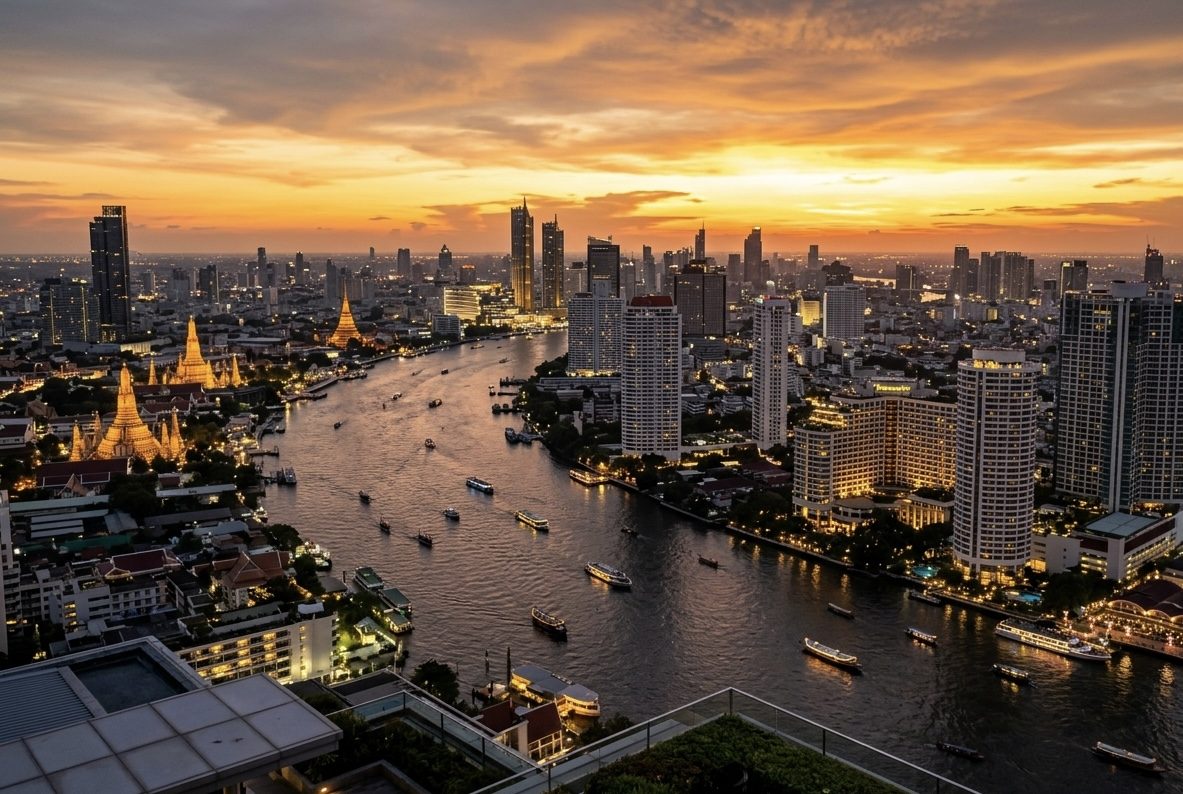
More families than ever are thinking about a second residency — somewhere stable, welcoming, and built for long stays without the bureaucratic friction of a typical visa renewal. In 2026, Thailand has quietly become one of the world's most considered destinations for that kind of move. This guide explains why — and how the Thailand Privilege Visa makes the relocation path simple, predictable, and family-ready.
The Shift Toward "Plan B Residency"
Until recently, the idea of a "second residency" was niche — something investors and high-net-worth families discussed quietly. That has changed. Across Europe, the Middle East, North America, and increasingly Asia, the conversation has gone mainstream: families want a stable place to live, work, educate their children, and build long-term peace of mind, even if they don't intend to move tomorrow.
Thailand fits that conversation differently from most destinations. It doesn't demand a property purchase. It doesn't require a multi-million-dollar investment. It doesn't make you prove income year after year. And it doesn't disappear when political winds shift — the program has been government-backed since 2003.
Why Thailand Specifically
Six structural reasons families choose Thailand as their second home:
1. Long-standing diplomatic neutrality
Thailand is the only Southeast Asian nation never colonized and has maintained working relationships with both Western and Asian powers for over a century. Its foreign policy has consistently emphasized stability and pragmatism — useful traits in any geopolitical climate.
2. World-class healthcare at a fraction of Western prices
Hospitals such as Bumrungrad International, Bangkok Hospital, and Samitivej are JCI-accredited and routinely chosen by patients flying in from Europe, the Middle East, and the U.S. for everything from routine care to advanced procedures. A specialist consultation typically costs USD 30–80; comprehensive private health insurance is widely available at affordable rates.
3. Family-friendly cost of living
A family of four can live comfortably in Bangkok or Chiang Mai for roughly 30–50% of what an equivalent lifestyle costs in London, New York, or Singapore — without sacrificing quality.
4. International schools across every major curriculum
Bangkok alone hosts more than 50 accredited international schools — British, American, IB, Singaporean, Japanese, French, German. Tuition ranges from THB 200,000 to THB 1,000,000 per year, with the upper tier comparable to top private schools globally.
5. Year-round climate and outdoor lifestyle
For families coming from cold climates, Thailand offers a tropical, predictable year. Bangkok's modern infrastructure, Chiang Mai's quieter mountain pace, Phuket's island lifestyle, and Hua Hin's coastal calm give families multiple chapters to choose from.
6. Cultural openness toward foreigners
Thailand has welcomed long-term foreign residents for generations. English is widely spoken in major cities and tourist hubs. Public attitudes toward expatriates are warm and pragmatic — you'll be a guest, but a respected one.
Why a Long-Term Visa Matters More Than a Tourist Visa
A 30- or 60-day tourist visa works for a holiday. It does not work for a relocation. Families building a Plan B need a legal status that:
- Lets them stay for years, not weeks
- Allows the family to come together, not just the primary applicant
- Doesn't require monthly border runs or annual income proof
- Is government-issued and stable across political cycles
The Thailand Privilege Visa is purpose-built for exactly this. It's a 5-to-20-year multiple-entry visa run by Thailand Privilege Card Co., Ltd., a state enterprise under the Ministry of Tourism and Sports. There's no minimum stay obligation, no income proof, no language test, no medical exam, and no investment requirement.
You pay one membership fee. You receive a long-term visa. You decide when and how long to be there.
How the Thailand Privilege Visa Fits a Relocation
For families specifically, three points matter:
1. Family members are eligible from the Platinum tier upward
- Platinum (10 years, ฿1.5M): add spouse, children, and the primary member's own parents at THB 1,000,000 per additional member.
- Diamond (15 years, ฿2.5M): same eligibility at THB 1,500,000 per additional member.
- Reserve (20 years, ฿5M): same eligibility at THB 2,000,000 per additional member.
Each family member receives their own multiple-entry visa, member card, and full VIP benefits — they are not "tagged on" to the primary member.
2. Approval is fast for a relocation timeline
Background checks and visa issuance typically complete in 30–45 days. Members can collect their visa stamp in Bangkok at the Chaengwattana immigration office, or have it affixed at Suvarnabhumi or Phuket airport on arrival with EPA support.
3. Payment only after approval
You don't pay the membership fee until your application is approved. If approval is denied, no fee is collected. This protects families considering the move from financial risk during the application phase.
For a step-by-step view, see our Thailand Privilege application walkthrough.
Choosing the Right Tier for Relocation
Not every family needs the most expensive tier. The right choice depends on stay length, family size, and lifestyle.
| Situation | Recommended Tier | Why |
|---|---|---|
| Solo applicant, 5-year horizon | Bronze or Gold | Lowest entry; family not eligible |
| Couple or family, 10-year horizon | Platinum | First family-eligible tier; strong value |
| Family planning 15+ years, premium lifestyle | Diamond | Adds complimentary domestic flights, more points |
| Ultra-long-term, invitation-only | Reserve | 20-year term, unlimited transfers, capped at 100/year |
A full side-by-side breakdown is on the membership comparison page.
What Relocation Actually Looks Like
Month 1–2: Decision and application
Engage with an authorized agent (such as Daimaru Trading, authorized GSSA since 2015). Submit application and required documents. Background check begins.
Month 2–3: Approval and visa issuance
Approval letter arrives. Membership fee paid. Visa stamped at immigration or affixed at airport on arrival. Member card issued.
Month 3–6: Soft landing
Many families spend 1–3 months "test-living" in Bangkok or Chiang Mai before committing to a full move. The visa allows unlimited entries — you're free to come and go as your transition requires.
Month 6+: Establishing the household
School enrolment, healthcare registration, banking setup, longer-term housing. The Privilege Entry Lane and dedicated member services support each step.
For a deeper view of daily life, read Living in Bangkok with a Thailand Privilege Visa.
How Thailand Compares to Other Relocation Visas
| Programme | Term | Family eligible | Income / investment proof | Stay obligation |
|---|---|---|---|---|
| Thailand Privilege Visa | 5–20 years | From Platinum up | None | None |
| Portugal D7 | 2 years, then 3-year renewals | Yes | Stable passive income required | Cannot be absent >6 consecutive or 8 non-consecutive months/year |
| Spain Non-Lucrative | 1 year, then 2-year renewals | Yes | 400% of IPREM (~€29k+/year, plus 100% IPREM per dependent) | Required (183+ days) |
| Malta Permanent Residence (MPRP) | For life (5-year renewable card) | Yes (spouse, children, parents, grandparents) | ~€99k government fees (€37k contribution + €60k admin + €2k donation) + property purchase €375k+ or rental €14k+/yr + €500k net worth (incl. €150k financial assets) | None |
| Malaysia MM2H | Silver 5 / Gold 15 / Platinum 20 years (renewable) | Yes (spouse, children <21, parents) | USD 150k / 500k / 1M fixed deposit + property purchase | 90 cumulative days/year (under 50) |
| UAE Golden Visa | 10 years, renewable | Yes (spouse, children any age) | Investment / talent / specialist routes | None (6-month absence rule waived) |
Thailand Privilege is unique in combining no income proof, no stay obligation, and a long term in a single package. It's not the cheapest option in absolute terms — but it's the most flexible.
For more detail on the alternative path inside Thailand itself, see Thailand Privilege vs the Retirement Visa.
Frequently Asked Questions
Can I relocate my entire family?
Yes — from Platinum upward. Spouse, children, and the primary member's own parents are eligible. Parents-in-law are not eligible. There is no age cap on children. See our full FAQ on family eligibility.
Do I have to live in Thailand to keep the visa?
No. There is no minimum stay obligation. You can spend a week, a year, or your entire term in the country.
Can I work in Thailand on this visa?
The visa is a long-stay residency, not a work permit. Members earning income outside Thailand (remote work, dividends, pensions) face no restriction. Members working for a Thai employer or operating a Thai business require a separate work permit, which is a standard process.
Is Thailand a stable country to live in long-term?
Thailand is a constitutional monarchy with a long history of attracting long-term foreign residents. The Privilege Visa programme has been government-run since 2003 and serves over 30,000 members worldwide.
How much does the full programme cost for a family?
A family of four on Platinum: THB 1,500,000 (primary) + 3 × THB 1,000,000 (additional members) = THB 4,500,000 total for 10 years of family residency. That's roughly USD 130,000 over a decade — or about USD 13,000 per year of long-term residency for the entire household. For full pricing, see Pricing.
Thailand offers what most relocation destinations cannot: a stable, government-backed long-term residency with no income proof, no stay obligation, and a clear family pathway from THB 1,500,000. For families building a Plan B, the Thailand Privilege Visa turns "considering relocation" into a documented, predictable plan.
Next Steps
If a long-term residency in Thailand is on your radar, the most useful step is a no-obligation conversation. Daimaru Trading is the authorized General Sales & Services Agent for the Thailand Privilege Card Co., Ltd. — winner of the Best Cooperation GSSA award three years running (2024, 2025, 2026).
We'll walk you through the timeline, documents, costs, and tier choice for your specific situation.
- → Start your application (no payment required until approved)
- → Compare all five tiers side-by-side
- → Read the complete 2026 guide